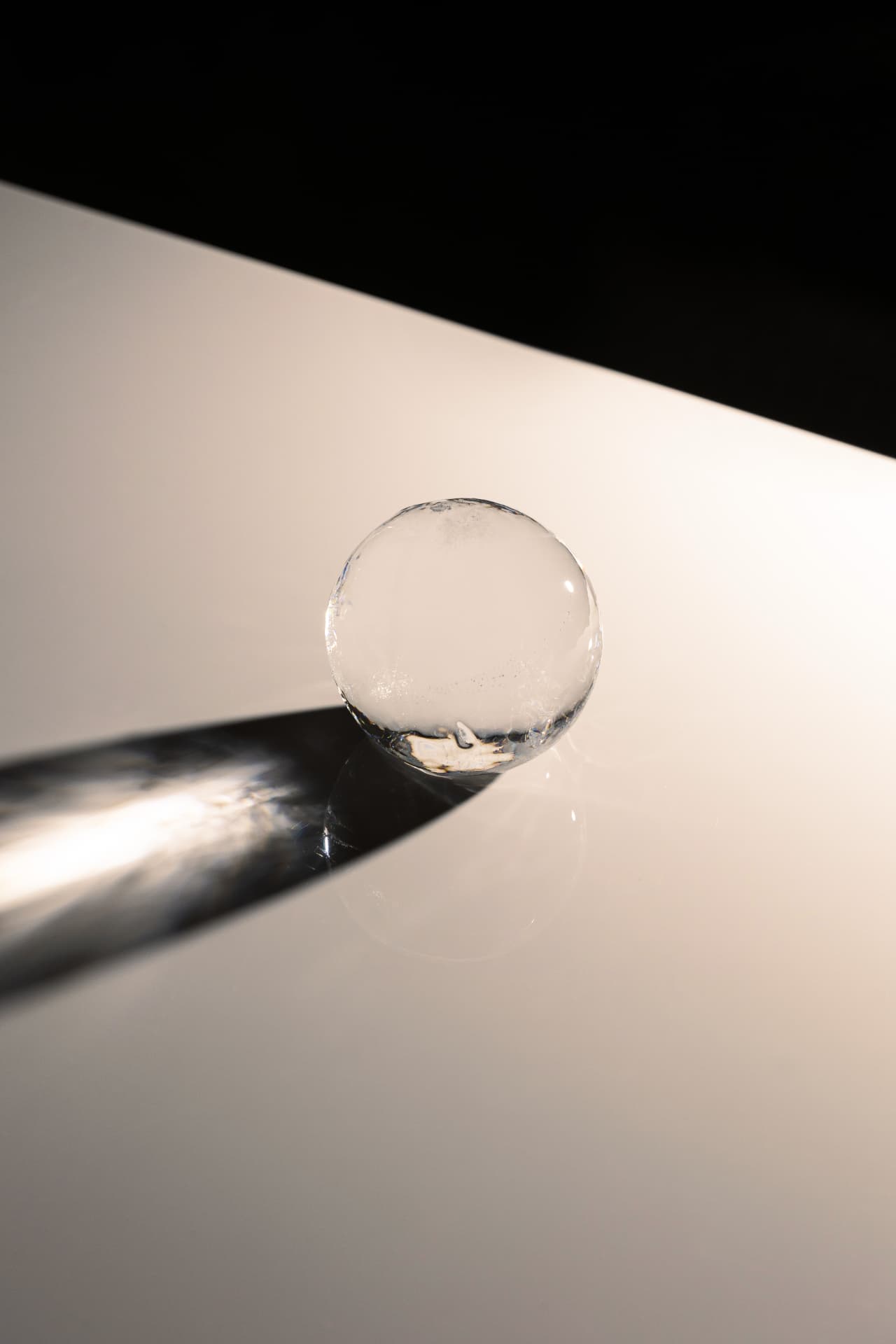
In most glasses, the ice cube is an afterthought, taken from the freezer tray without a second look. Yet it is the element that stays longest in contact with the spirit. Its shape, its clarity and its melt decide what you taste, sip after sip.
The ordinary ice cube
Ice made at home freezes quickly, from the outside in. Air and minerals stay trapped at its core, which gives it its white, cloudy look. Small and numerous, cubes offer the spirit a large surface: they melt fast and water the glass down more than they serve it.
The ice sphere
For the same volume, a sphere has the smallest possible surface. It melts more slowly, cools the glass gradually and dilutes with restraint. The spirit keeps its structure and reveals itself at its own pace.
The Rocks craft
Each The Rocks sphere is born of Swiss mineral water from the Mont Blanc massif. It is slowly crystallised over thirty-six hours, then shaped by hand in Switzerland. This patience gives ice of remarkable clarity, which sits in the glass as a piece in its own right.
How to serve it
- Take the sphere from the freezer and place it with tongs in a heavy-based tumbler.
- Let it rest for a minute before pouring.
- Pour slowly, directly over the sphere.
- Keep the spheres at -18 °C, for up to two months in the freezer.
Which glasses
A single malt, an old rum, a cognac, a negroni or an old fashioned. Wherever the drink is meant to be savoured, the sphere takes the place of ice cubes.